

The art of beverage paired with
the business of restaurants
Innovative Beverage Strategies That Make More Money
We are a team of experienced beverage directors, curating wine and spirits programs for unique restaurant ecosystems —
Plugging into your restaurant’s beverage program to deliver measurable and scaleable profits.

Book a strategy session
Whether your beverage program is strong or struggling, we make it better
Appearances
Drinking On The JobPodcast:
Hospitality Bites Podcast:
Our operators typically see a 10-20% boost in sales within their first year,
with a growing base of repeat clientele.
We Build Your Beverage Program
All products are selected with care based on your ecosystem.
Triage
Identifying pain points and transforming them into opportunities.
Systems
Operational flow, product continuity and tech infrastructure guidance.
Analytics
Tracking changes, informing intentional beverage strategy.
Profit-Minded Curation
All products are strategically positioned to increase check averages and tips.
Sales Training
Coaching for driving gross sales.
Our proven strategy unlocks untapped, high-profit wine demographics at every pricing tier that
fill restaurants, streamline operations and increase staff morale.
2026 Case Study: Wine Program Strategy
How one iBEVs client's Red Burgundy program generates more profit per bottle than categories running 11 points cheaper
and what that means for how you think about your wine list:
Client: Cecchi's Restaurant
(tracked across three years of quarterly data)
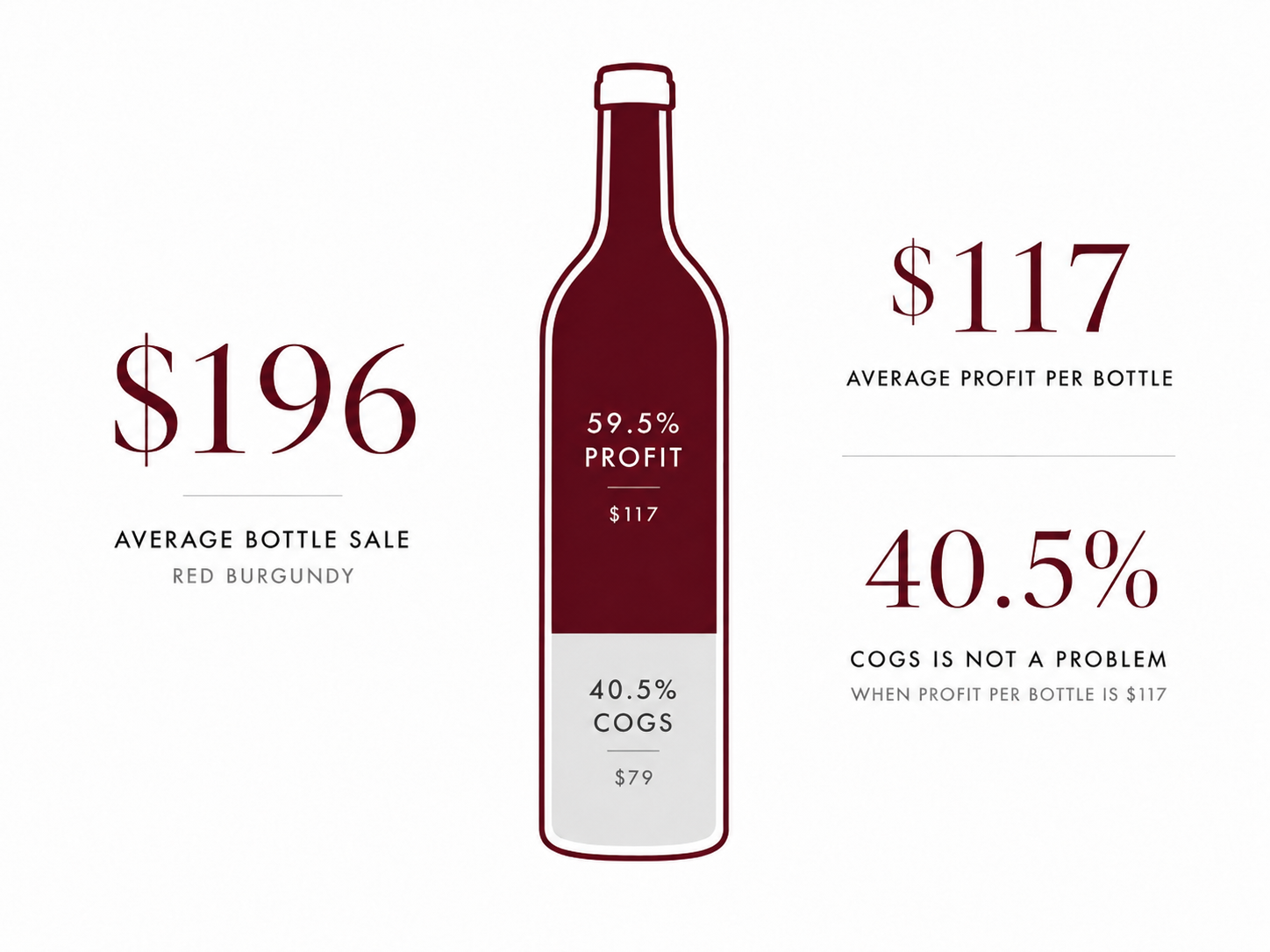
Every operator learns to watch their cost percentage. It's the first number a consultant will look at, and for good reason; runaway costs sink restaurants. But cost percentage is a ratio, and ratios can mislead you. At Cecchi's, the Red Burgundy program runs at roughly 40% COGS.
On paper, that looks like a problem. In practice, it's one of the best-performing sections of the wine list.
The question isn't what percentage of revenue went to cost, it's how many dollars of profit landed in your pocket after each sale.
A $196 bottle at 40% COGS leaves $117 of profit. That number tells a very different story than the percentage alone.
The comparison that changes the frame
Consider two sub-categories on Cecchi's bottle list in Q1 2026. Both are strong sellers. The COGS numbers look very different.
The profit numbers tell you what actually matters.
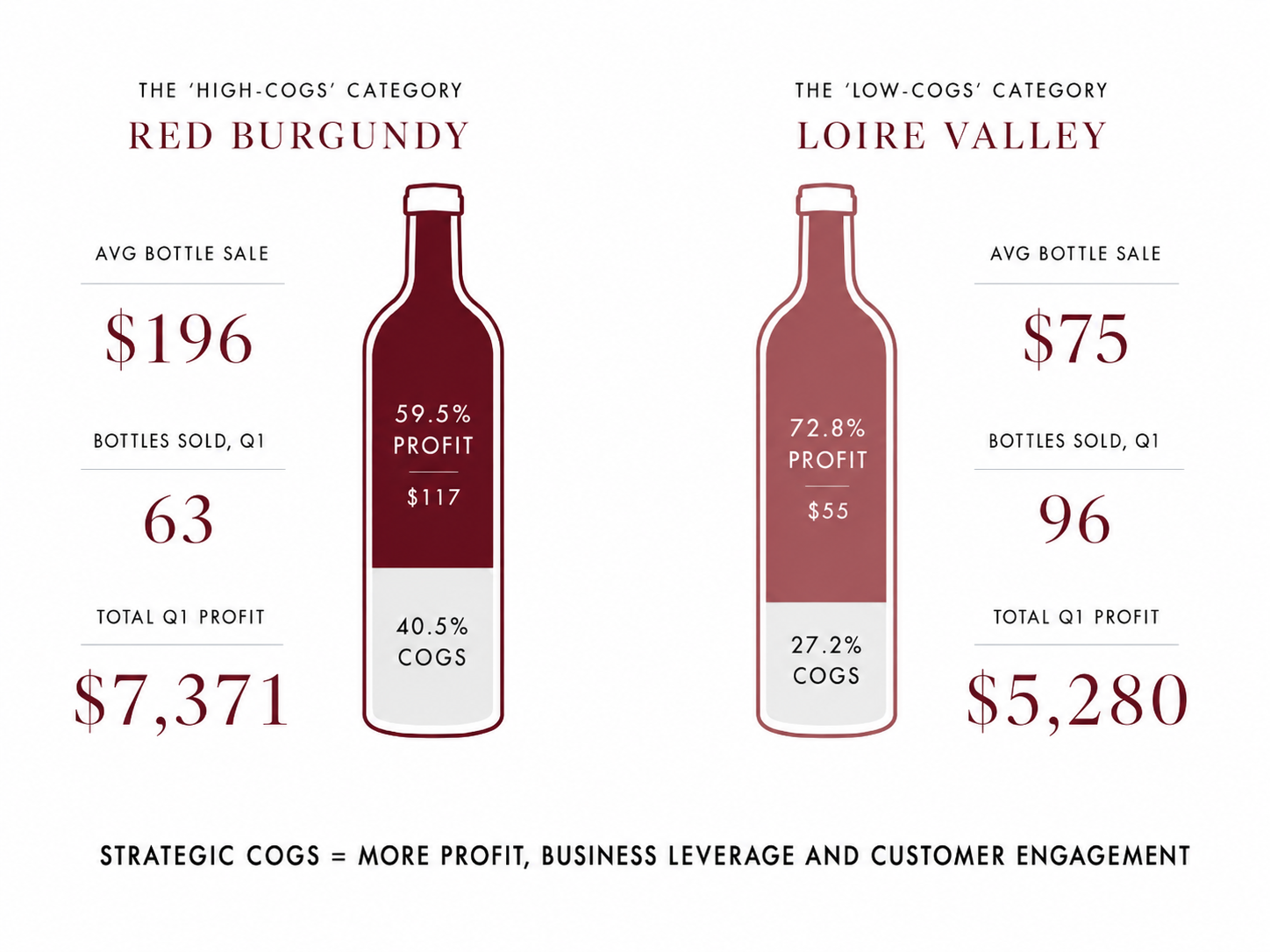
Loire runs 13 points cheaper on cost percentage and moved 52% more bottles. A spreadsheet optimizer would call Loire the winner. But Red Burgundy generated $2,091 more total profit on 33 fewer bottles sold, because
every bottle that left the floor put $62 more in the owner's pocket. That gap compounds across a full year.
“Serious wine buyers notice when a list is priced fairly at the high end. That trust translates into orders, and those orders translate into profit that a lean cost percentage on a $75 bottle simply cannot match.”
The strategy behind the numbers
The standard markup formula: multiply your cost by three or four. This works reasonably well at the lower end of a wine list. Applied uniformly to a $50 wholesale bottle, it produces a price that stops the conversation before it starts. Serious wine buyers, the guests who might spend $200 on a bottle, are also the guests who know what things cost. They notice when a list is priced with integrity. That recognition translates into orders.
The iBEVs approach at Cecchi's is deliberately blended. On higher-ticket bottles, we price to reflect genuine value. Less markup, more accessibility, more volume. On mid-range bottles, there’s more room to work. The program is optimized for total profit generated across the list, not for a tidy cost percentage that looks good on a report but limits who’ll actually buy a bottle of wine with dinner.
The result, tracked across three years of quarterly data: average profit per bottle has held above $89, even as the mix of wines on the list has shifted and overall market conditions have changed. The model is durable because it's built around guest behavior, not accounting conventions.
What this means for your wine program
Cost percentage is a useful diagnostic, but it’s ratio tells you nothing about absolute dollars unless you know the revenue behind it.
On high-ticket categories, aggressive pricing can increase both volume and total profit simultaneously. The math works in your favor.
The right question is not "is my COGS too high?" It is "am I maximizing profit per bottle sold, across the full range of my list?"
A blended approach: tighter margins where the sale price is high, more margin where the price is modest produces better total outcomes than a uniform markup formula applied list-wide.
Three years of clean data at Cecchi's confirms the model holds through menu rotations, list changes, and volume fluctuations.
This is kind of analysis is run for every client.
iBEVs works with restaurant operators to build beverage programs that are analytically grounded, practically executable, and genuinely profitable. If the thinking in this case study resonates,
we'd like to show you what it looks like applied to your list.
Data sourced from Margin Edge sales exports, Q1 2026. All figures represent cleaned data. Cecchi's is a current iBEVs client; data published with permission.